Introduction
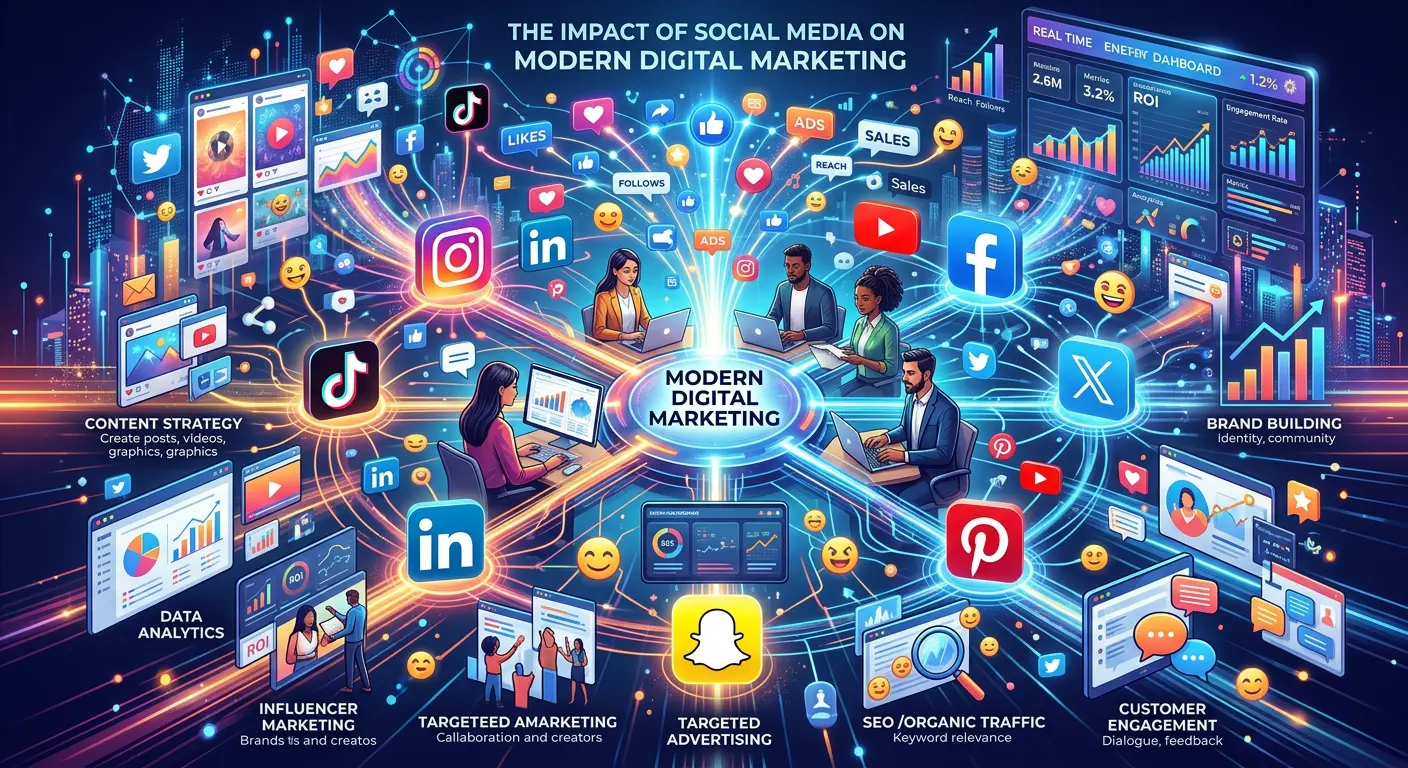
The Social Media Impact On Modern Digital Marketing landscape has changed significantly over the past decade. Businesses no longer depend only on traditional advertising, newspapers, television, and billboards to reach potential customers. The social media impact on modern digital marketing can be seen across almost every industry, from small businesses and startups to large global brands.
With billions of people using platforms such as Facebook, Instagram, LinkedIn, YouTube, and businesses have access to a large and diverse audience. As a result, social media has become an essential part of modern marketing strategies.
Social platforms allow companies to communicate directly with their target audience, understand customer preferences, promote products and services, and build long-term relationships. Unlike traditional marketing, where communication is often one-way, social platforms encourage conversions and interactions between brands and consumers.
Social Media Marketing
Social media marketing involves using social networking platforms to promote a product, business, service, or brand. It includes activities such as running advertising, creating content, engaging with followers, responding to comments, collaborating with influencers, and analyzing audience behavior.
Businesses can publish educational articles, short videos, polls, product demonstrations, infographics, and other forms of content. These activities can increase visibility while helping businesses understand what their audiences actually want.
The social media impact on modern digital marketing is particularly important because these platforms combine communication, content, advertising, and analytics in one environment.
Increase Brand Awareness
A business can introduce itself to thousands or even millions of potential customers without relying entirely on expensive traditional advertising.
The social media impact on modern digital marketing becomes especially visible when valuable content is shared by users. A single post or video can reach audiences beyond the company’s existing followers, creating opportunities for organic growth.
Direct Customer Engagement
Traditional marketing often provides limited opportunities for immediate interaction. Social platforms have changed this by allowing customers to communicate directly with business.
Customers can comment on posts, send direct messages, participate in polls, ask questions, and provide feedback. This interaction is valuable because customers increasingly expect brands to be accessible and responsive. A quick and helpful response can improve customer satisfaction and strengthen trust.

More Personalized Marketing
The Social Media Impact On Modern Digital Marketing have modern consumers are exposed to a large amount of advertising every day. Generic marketing messages may therefore struggle to attract attention.
Businesses can study factors such as demographics, interests, engagement patterns, content preferences, and online behavior. These insights can be used to develop content for specific audience groups.
For Example, A fitness company can create different campaigns athletes, and people interested in healthy lifestyles. Personalized communication can make marketing messages more relevant and potentially improve engagement.
This another major example of the social media impact on modern digital marketing, as businesses can use audience information to make their campaigns more targeted.
Social Media and Content Marketing
Businesses can use social platforms to distribute blogs, guides, podcasts, videos, case studies, infographics, and other educational materials.
A well-written blog can attract visitors to a website, while a shh]ort social post can encourage users to read the complete article. Similarly, a long video can be transformed into multiple short clips for different platforms.
The social media impact on modern digital marketing has therefore encouraged marketers to think about content as an ongoing conversation rather than a one-time advertisement.
Influencer Marketing
Influencer marketing has become another important part of digital promotion. Influencers have established communities around specific interests, industries, lifestyles, or areas of expertise.
A partnership should feel relevant rather than forced. Businesses can collaborate with suitable influencers to introduce products or services to highly relevant audiences. The social media impact on modern digital marketing has made influencer collaborations accessible to both large companies and smaller businesses.
Social Commerce and Lead Generation
Consumers may discover a product through a video, visit, a brand’s profile, read reviews, ask questions, and eventually make a purchase.
Businesses can also use social advertising campaigns to generate leads. Lead generation forms, promotional offers, website links, and direct messaging can help move potential customers towards conversion.
The social media impact on modern digital marketing is therefore closely connected to lead generation, customer acquisition, and revenue growth.
Social Media Analytics
Another important advantage of social marketing is access to performance data. Businesses can monitor metrics such as impressions, engagement, clicks, reach, follower growth, and conversions.
These metrics help marketers understand which type of content perform well and which strategies need improvement.
Analytics also allow marketers to identify trends and understand changes in audience behavior.
Building Brand Trust and Reputation
Trust is an important factor in purchasing decisions. Social platforms give businesses an opportunity to demonstrate their expertise, values, customer service, and personality.
Businesses can share customer testimonials, product information, company achievements, educational content, and behind-the-scenes activities. This transparency can make a brand appear more authentic.
The social media impact on modern digital marketing includes both opportunities and responsibilities. A strong online presence can improve reputation, while poor communication can damage customer trust.
Paid Advertising and Better Targeting
Organic reach can be useful, but businesses can also use paid social advertising to reach specific audiences. Modern advertising platforms provide marketers with targeting options than can help campaigns reach people based on factors such as demographics, interests, location, and online behavior.
Businesses can also test different advertisement and compare their performances. This data-driven approach allows businesses to improve campaigns over time instead of relying entirely on assumptions.
As advertising technology develops, the social media impact on modern digital marketing will continue to influence how businesses allocate advertising budgets and measure campaign performance.
Challenges of Social Media Marketing
Despite its advantages, social marketing also has challenges. Competition for attention is extremely high, and users see a large amount of content every day.
Algorithms can change, organic reach can fluctuate, and trends can disappear quickly. Businesses also need to maintain consistency and respond to customers in a timely manner. Privacy, misinformation, negative comments, and reputation management are additional concerns that marketers must consider.
Future of Social Media in Digital Marketing
The future of social marketing is likely to become increasingly connected with artificial intelligence, automation, personalization, social commerce, and data analytics.
The social media impact on modern digital marketing will continue to evolve as consumer to evolve as consumer behavior and technology change. Companies that continuously test new strategies and understand their audiences will be better positioned to adapt.
Business will need to focus not only on gaining followers but also on creating meaningful relationships and delivering value.
Conclusion
The social media impact on modern digital marketing is significant because social platforms have transformed how businesses communicate with customers. They provide opportunities for brand awareness, customer engagement, personalized marketing, lead generation, content distribution, influencer collaborations, paid advertising, and performance analysis.
As digital technology continues to develop, social platforms will remain an important part of the modern marketing ecosystem. Brands that use these platforms effectively can build stronger relationships, increase visibility, generate leads, and create long-term relationship business growth.
Ultimately, the biggest lesson is simple: modern digital marketing is no longer just about reaching customers- it is about creating conversations, providing value, and building trust.
Leave a Reply